

Getting to the Root – Creating the Picture
Previous Posts in this series:
Getting to the Root – Introduction
Getting to the Root – Establishing the Frame
Now is the time to bring the colour to your master work…
In the diagram I shared earlier, we can see that How?, When?, Who?, and Where? all sit in the centre and overlap with each other. This is because discoveries in one area can influence the choices that we make in the others.
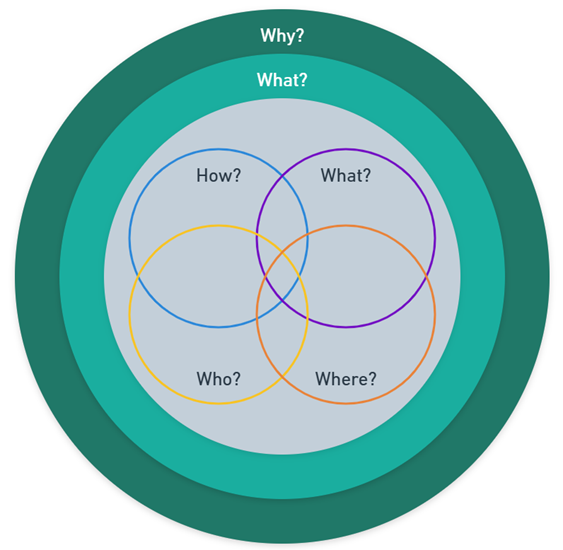
In reality, we can even find the insights we discover lead us to redefine elements of our what too.
Every endeavour is unique and it is impossible to forecast what we may uncover and how these relationships will influence each other. A mantra I can offer is this:
Keep this in mind as you explore these perspectives and embrace the emergent nature of your planning.
How?
We have our what, now we need to uncover what tasks and activities are involved in making manifest our what. This is our how…
- What are the main tasks involved in this?
- Do they group up in to areas or themes?
- Is the sequence of tasks clear?
- Where are the unknowns?
- Do we need to prioritise addressing the unknowns?
- How much risk do they carry?
- What is inside/outside of our control?
- Have we done this before?
- What lessons did we learn that could be applied?
- Have other people done this before?
- Are they people that we know that we can speak to for insights?
- Is there a blueprint available online?
- Do I have or have access to all the skills needed to complete the tasks?
- Does access to the required skills incur a cost, and is this factored in to our budget?
- What matters more speed, or quality?
- What trade-offs can I/we make?
When?
Ensuring the goal is time-bound and has an establish a deadline.
The when makes all the difference as it can be a deciding factor for perceived stress and pressure. For me personally, I love a good deadline and thrive under pressure, this cannot be said for everyone though. That is why is it key to get our when questions answered early to ensure we are super clear around expectations. This is a key part of contacting with ourselves and others.
When is also interesting as it can have a significant impact on the what if the timing determines the value of the what.
- Is there a hard deadline for this?
- Why?
- Does the when apply to the whole, or is it different for different parts?
- Does the value of the thing change based on when I do/achieve/have it?
- How much time can I realistically allocate to doing this thing?
- Does this change the when?
- What am I not doing because I am choosing to do this?
Who?
As much as we like to think we are independent operators, the reality is we live in an interconnected world where we depend on support from others either directly or indirectly to achieve our goals.
Who we require and their availability can impact our when, so it is important to start exploring this area early in your analysis.
- Can I do this all myself?
- Do I know who I need to help?
- Do I have access to these people?
- Am I looking for skills, experience or both?
- Have a factored in the cost of the help required?
- Think back to if there is anyone to learn from – can they help signpost the right people to engage with?
Where?
This feels a bit captain obvious, but when it comes to achieving complex goals that rely on the involvement of many people, the where can make a big difference. Especially early in a project, people meeting up face to face to collaborate and gather round a white board can allow lasting relationships to form that will enable more effective collaboration once times get tough later in the delivery.
When it comes to our solo missions and we need some head down time to think, do we have a protected space so we can focus?
- At home?
- Which room?
- Do I have everything I need to focus and be productive?
- What changes can I make to enable this?
- Do we have a space in the office where we can all get together?
- Where is everyone based?
- Can we all consistently travel in?
- How frequently can we get together?
- How much will it cost to get the team together face to face?
What’s Next?
The picture is painted and now we need to bring it in to focus with the final details.
So in the next and final post of this series we will explore three complimentary analysis strategies along with the benefits and practical applications of the tool as a whole.

Enjoy, for now.
Previous Posts – Getting to the Root – Establishing the Frame