

Getting to the Root – Introduction
What is it?
Placed right at the start of the approach toolkit, the Getting to the Root tool is all about appreciating that our perspective on a challenge determines what solution we deliver and how we deliver it. You could think about it a bit like an applied version of the pliable perception tool.
When a new challenge is presented (this could be given to us in a work context or identified by us in a personal context), the first thing we need to do is mentally frame it accordingly. This enables us to have a clear agreement around what is to be achieved while also having defined boundaries for both how we need to approach it, and the quality standards required.
Getting to the Root is a set of questioning strategies designed to help you do this. Another term for this is critical thinking – the ability to analyse, evaluate, and interpret information to form rational judgements.
Being a delivery professional, planning is my thing. Now that may sound a bit bland and boring, but my reality is that this early phase is one of the most exciting bits! I view this as the early reconnaissance which enables me to define the boundaries of a blank canvas and determine the artistic materials and colour pallet that I am able to use to create my work of art.
Sometimes I am the artist commissioned by a customer, sometimes I am both the customer and the artist. Either way the same approach applies.
How does it work?
The core of this tool is a set of questioning strategies that you can apply to help define, refine, and shape both your goals and plans to achieve them.
There are logical times to use each of the questions, but no pathway up the mountain is ever straight, once you understand the questions, apply them at any time you see fit. Be aware though that if you revisit your why? or what? when you are already some ways down the track, this will mean potentially starting again with your planning and goals. Sometimes this is required, but ideally it is best avoided as it will lead to waste.
We avoid this waste by spending time with our what and why and locking this stuff in as best as possible before we progress. Ultimately though there will be times where we don’t get this right and we must revisit our whys and what’s. In this case it is better to write off the waste accumulated so far and avoid accumulating more rather than just burying our heads in the sand and carrying on regardless. This is the sunk cost fallacy.
To help put the insights that will follow in to context, it will be useful for you to think of a range of challenges that you can apply them to. I say range because the questioning strategies I will share can be applied to both big and small challenges but are more relevant in some cases than others.
You can use examples from either a personal or professional context things such as: Buying a new house or car, planning a party, building a mobile application, reorganising a library, fixing a problem, or redesigning your garden. The list is endless. Just think of a few examples that are relevant to you and use them to test out the questions as you progress.
Before we get going with the questions, let’s just look at a very important detail…
Keep a Record
The human mind is a wonderful thing and we can store endless amounts of information. If you want to quickly share information though, it needs to be written down either physically or digitally.
Capturing both your questions and the answers you find allows you to easily return to them in the future and to share them with other people. More important than that though, the act of sorting the information outside of your mind frees your mental capacity to process the information, identify solutions and work out your next steps.
Taking thinking of your examples as an example, if you write them down so you can refer to them later, in the moment of referral where you ponder how one of the questions applies to one of the examples, you will focus more clearly and get better results if at the same time you are not trying to not forget the other two examples.
So, write things down as you go, but don’t be afraid to learn something new that means you need to disregard all your previous thinking and start again – such is the joy of emergence in planning!
Next, we are going to move on to exploring the different questioning approaches, but in the spirit of writing things down, here is a little visual map of how all of the questioning areas fit together:
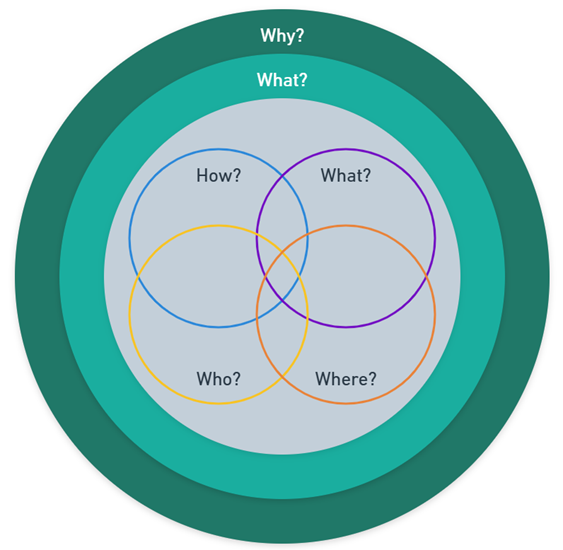
Refer back to this as you navigate the question to help refine your internal visual map of how they fit together. This will make more sense once you read on, but do come back to refer to it as you need or want to.
What’s Next?
It is time to start defining our frame with some powerful Why? and What? questions…

Enjoy, for now.